Can a Viking game inspire real history interest without teaching history?
A Viking game does not need to pause for a lecture on trade routes, burial customs or tenth-century politics to make someone curious about the past. Sometimes all it takes is a longship cutting across a grey sea, a settlement appearing over the ridge, or a shield-wall forming in the middle of a fight. The player notices something, wonders whether it is true, and goes looking.
That is not the same as learning history from the game. A game may borrow the look of the Viking Age while changing its people, timelines and events to suit the story. But it can still act as a starting point: a vivid invitation to ask better questions. The trick is to treat what appears on screen as a prompt, not proof.
Games build a visual vocabulary quickly
Historical games are good at giving us a visual vocabulary. We recognise the longship, the round shield, the timber hall and the cluster of buildings beside a river before we know what any of them meant to the people who used them. Repetition does the work. A ship is not just a decorative object if we have sailed in one; a settlement is not just a backdrop if we have walked its paths and watched its stores fill.
This is one of the distinctive strengths of games. A film can show a Viking ship in a memorable sequence, but a game can ask us to steer it, land it and return to it. A shield may appear in a film for a few seconds; a game can put one in our hands for hours. That repeated contact can make details stick, even when the game never explains them.
Of course, familiarity can be mistaken for accuracy. A player may come away convinced that every Viking settlement looked like the one in the game, or that every warrior carried the same equipment. Visual coherence is not historical evidence. Developers need a recognisable world, and familiar images are useful shorthand. The same design choice that helps us understand a game’s setting can quietly narrow our idea of the past.
Ships, shields and settlements
Longships are an especially powerful image because they connect several ideas at once: travel, trade, migration, raiding and political reach. Their shallow draught helped make it possible to navigate some rivers as well as coastal waters. But a game’s fleet of fast, dramatic ships can encourage the impression that Viking life was mostly a matter of sailing off to raid. People in the Viking Age also farmed, made goods, traded, governed communities and travelled for many reasons.
Shields work just as efficiently as visual shorthand. A line of round shields suggests a disciplined group and an imminent battle. Yet screen-friendly uniformity may conceal variety in materials, decoration, condition and use. The historical record does not provide a complete kit list for every person, region and decade. Asking what a game leaves out is as useful as asking what it gets right.
Settlements offer a different kind of clue. A hall, workshops and homes can make a fictional world feel lived in, and can prompt questions about work, food, social status and community. But one carefully designed village is not a universal model of Viking settlement. Archaeology reveals varied places and patterns, and a game’s need to keep locations readable can simplify that variety.
Games establish a setting at a different speed from film
Film often has to establish a historical setting in a handful of images. Costumes, a landscape, a ship and a familiar musical cue may tell us, almost instantly, “Vikings”. That compression can be elegant, but it also favours strong, easily recognised symbols. A horned helmet communicates “Viking” to an audience even though it is a misleading choice for a warrior’s battlefield headgear.
Games have more time, and a different toolset. The player can revisit a harbour, cross the same landscape in different weather, or see a settlement change as the story progresses. Instead of receiving a single establishing shot, we inhabit a sequence of spaces. That duration can make history feel less like a costume drama and more like a place with practical demands: where to land, what to carry, how far to travel.
Yet duration is not a guarantee of depth. A game can let us spend dozens of hours in an invented world without teaching us how much of it is invented. Interactivity makes a setting memorable; it does not automatically make its account reliable. A game can be immersive and historically loose at the same time.
The horned helmet: a myth with staying power
The horned Viking helmet is an excellent example of an image that refuses to disappear because it is so easy to read. Horns make a silhouette unmistakable. They turn a helmet into a costume, a logo or a toy design at a glance. In a crowded scene, they help an audience identify “the Viking” without needing any other context.
That visual usefulness is part of why the myth persists. It has circulated through popular art, theatre, illustration, advertising and entertainment, gathering familiarity each time it appears. Nineteenth-century romantic depictions, including influential stage designs for Wagner’s operas, helped cement the look in popular culture. Once an image becomes familiar, it can feel traditional even when it is not a good guide to historical evidence.
There are also practical reasons to be cautious. Projections such as horns would be awkward and vulnerable in combat. More importantly, the helmets we can examine do not support the standard screen image of horned Viking warriors. This is not a claim that no person in the Viking Age ever wore a horned object for any purpose. It is a reminder that the familiar horned battle helmet is not established by the archaeological evidence as ordinary Viking war gear.
Gjermundbu: a useful reality check
When the horned helmet appears in a game, the best response is not necessarily to tut and switch off. It can be a doorway to a better object: the helmet from Gjermundbu, found in Norway and associated with a tenth-century burial. It is widely described as the only substantially complete Viking Age helmet known from Scandinavia. Its iron construction includes a rounded cap and a distinctive spectacle-like face guard. It has no horns.
One find cannot tell us what every warrior wore. Preservation is uneven, and metal equipment could be reused, damaged or lost to time. The scarcity of surviving helmets is itself a reminder to be careful about sweeping claims. Still, Gjermundbu gives us a material point of comparison: not a modern fantasy design, but an actual object recovered from https://historymedieval.com/vikings-on-screen-history-myth-and-gaming/ the ground.

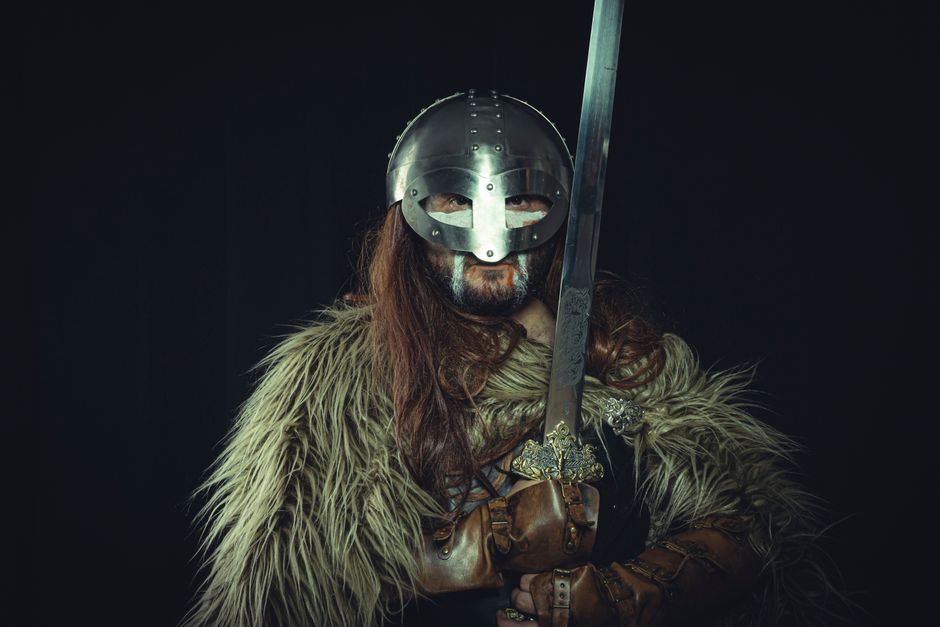
Looking at it also changes the question. Instead of asking, “Why did Vikings wear horns?”, we might ask, “What protection did this helmet offer?”, “How was it made?” or “Who could afford equipment like this?” Those questions lead away from costume shorthand and towards craft, status, violence and the limits of what archaeology can tell us.
From game image to curiosity-driven research
The most useful habit is simple: follow the image back. Start with something striking in the game, then trace it towards evidence. If there is a longship, ask what archaeological finds and written sources tell us about ships and their uses. If there is a settlement, look for excavation reports, museum collections or well-researched introductions to everyday life. If there is a helmet with horns, compare it with the Gjermundbu find and ask how the popular image developed.
This is curiosity-driven research, not a test of whether someone has memorised dates. It begins with an image that has already caught the imagination. A player does not need to know the right question in advance; the first question can be as modest as, “Did Vikings really wear that?” From there, the answer may lead to another question, and then another.
- Notice the detail. Pick one object, place or custom that held your attention.
- Separate the game’s choices from its claims. Is the detail there for gameplay, atmosphere or a specific historical reason?
- Look for material evidence. Museum collections and archaeological finds can give you objects to compare with the on-screen version.
- Check more than one reliable source. A confident caption or social post is not the same as a supported explanation.
- Keep uncertainty in view. Evidence may be incomplete, and a careful answer can be more interesting than a definite one.
For readers who want to continue, HistoryMedieval can be one place to explore historical topics, while a museum catalogue or archaeological resource can help ground a particular object in evidence. The useful question is not whether a source sounds authoritative, but what evidence it uses and whether it distinguishes what is known from what is inferred.
What about games made for entertainment?
Not every Viking-themed game sets out to teach. Some are built around action, fantasy or spectacle; others aim for a convincing historical atmosphere but still compress events and invent characters. That is not automatically a problem. Historical fiction is allowed to be fiction. The trouble starts when a memorable design is mistaken for a neutral record of the past.
Names such as Mr Q and MrQ may appear in entertainment contexts where Viking imagery is used to make a game feel bold or adventurous. That imagery can attract attention, but it should not be treated as a history lesson simply because it draws on historical-looking symbols. For cultural writers and players alike, the distinction matters: an enjoyable game can inspire interest without being a reliable source about the period.
That distinction is also fairer to the game. We can enjoy its pacing, atmosphere and visual design while asking where it has taken liberties. The aim is not to turn every play session into homework. It is to leave room for a second look when an image lingers after the screen goes dark.
So, can a Viking game inspire real history interest?
Yes, if we understand “inspire” as opening a door rather than delivering a lesson. Games can make ships, shields and settlements feel tangible. They can establish a setting through repeated movement and choice in ways that film’s brisk visual shorthand cannot. And their inaccuracies can be productive, provided we notice them and follow the image back to evidence.
The horned helmet is not just a mistake to correct; it is a chance to ask how popular images are made and why they last. Gjermundbu is not a complete answer to Viking warfare; it is a real object that helps us test a familiar story. Between the invented world and the historical record sits the player, curious enough to check.
A game need not teach history to make someone want to learn it. Sometimes the strongest beginning is a striking image, followed by a small, honest question: “Was it really like that?”
Share or save this article
Print Article (PDF/print function) — use your browser’s print options to print or save this page as a PDF.
Facebook share — share the article with someone who has ever wondered whether Vikings really wore horned helmets.